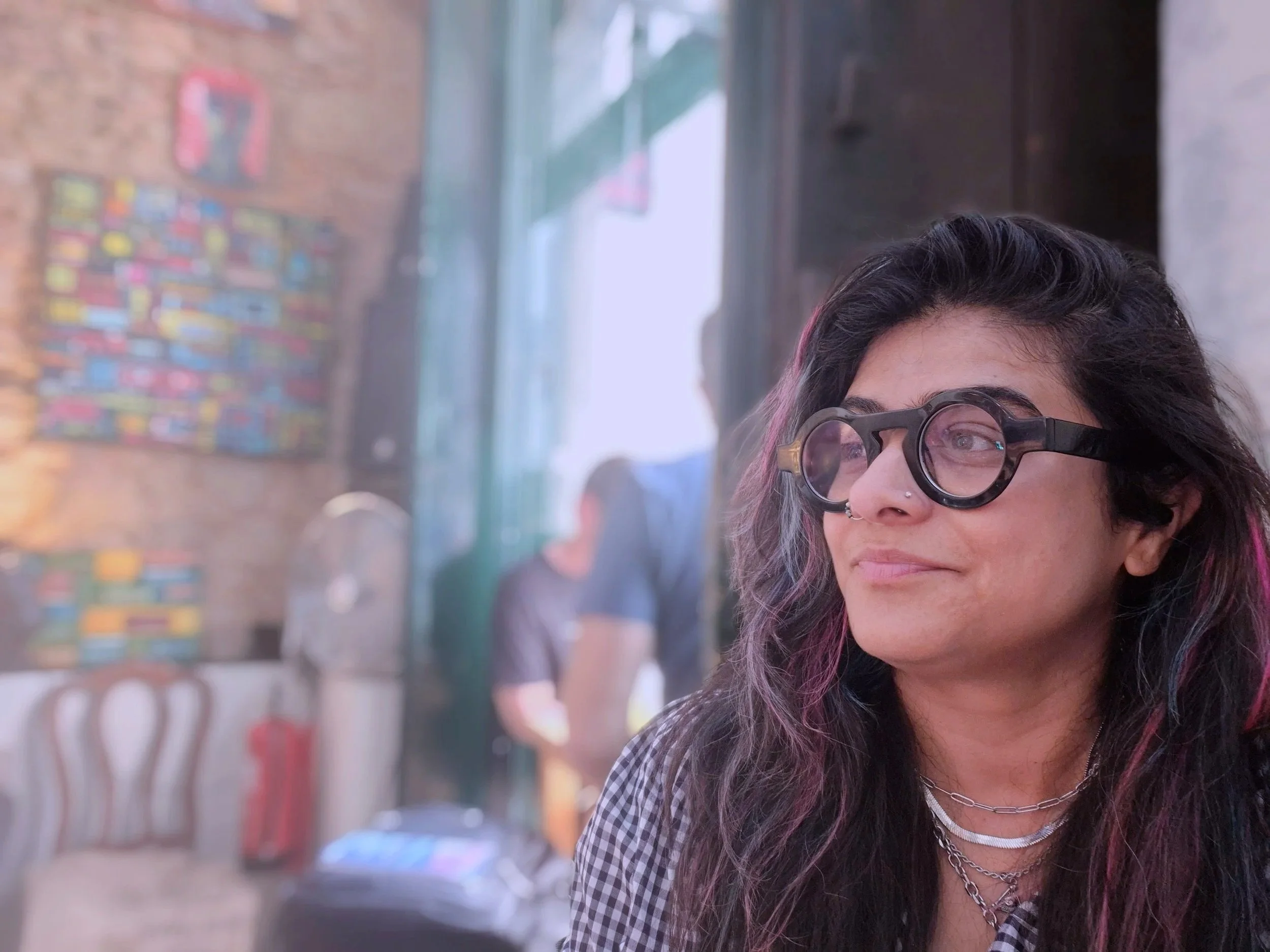
Ekta Hattangady (they/she)
Liberation coach, spiritual guide, facilitator and trainer
A bit about me:
At 18, I decided to end my life. I believed I was unlucky. A boy I loved had left me. My mother was on her deathbed after a long illness. I had dropped out of college because it was hard to care for my mom and be a student, or a regular teen with the usual angst - there was no space for that. I saw no future for me.
At 45, I am the happiest I have ever been. My journey has not been linear. A combination of yoga and psychotherapy brought me to a precipice in my healing, and finding the Buddhist framework of ethical living, mind training and wisdom-orientation catapulted me into a far freer dimension. Even as my body transitions into (peri)menopause. The symptoms are challenging; my capacity varies daily. Yet, amidst the grief that comes with change, I feel purposeful. I see my place in the world.
My vision is to use healing of the self as a channel through which people find their purpose, their unique hue in the collective liberation rainbow. Healing is not the destination, rather a milestone in our liberation.

The backstory
I come from a Jain-Hindu, Gujarati-Konkani household, an inter-caste, interfaith family, quite uncommon when I was young. It was hard to be a third culture kid even while being in India. But it also shaped my expansive, multicultural mindset. I grew up fasting for Paryushan with my mom, which would end in a feast because Samvatsari, the last day, and Ganesh Chaturthi would fall on the same day - one of the main festivals on my father’s side. It remains my favourite dual celebration from childhood.
I also attended an extremely diverse girls’ school where we celebrated every festival. I studied with children of major business house owners, and those whose parents worked as domestic workers. It was powerful. While there were cliques of rich kids, the rest of us interacted without concern for status, religion or caste. This rich cultural tapestry coexisted with immense suffering.
Like many South Asian children, I grew up witnessing my mother being harassed by my grandparents, and my father being silent and submissive. As a dutiful Indian child, I kept this a secret and as a result internalized many negative beliefs about myself, family and the world. These beliefs only got reinforced, when my mother, my anchor, was diagnosed with Young Onset Dementia in her mid 40s, after being symptomatic for several years before. Watching my mother, my only champion, slowly die made me believe that the universe was against me, that I was talented, but nothing good would ever happen to me. I lived with rage and depression for over two decades. It was in my mid 30s that I realized I was living with C-PTSD.
The Metamorphosis
I remember the exact moment when things began to shift. It was at my first Vipassana retreat, and I heard S.N. Goenka teach the First Noble Truth. He said, “Suffering is an inevitable part of life.” A weight and a veil were lifted off me. I realized that I was just like everyone else. The universe did not have a vendetta against me. I learned that while suffering was not my choice, I could influence my response to it.
A daily meditation practice shifted the intensity and frequency of my mood shifts, especially bouts of rage. I began to feel confident. I finally felt like I could make ‘good’ things happen, and if not, I could train myself to suffer a lot less.
Meditation, or mind training, is a crucial pillar of Buddhism, and I gained insight into textual and lived wisdom experientially. The emphasis on practice and direct experience attracts me to this framework to this day.
Sila, the pillar of ethical living, taught me that I had a responsibility to reduce the harm I caused in the world, knowingly or unknowingly. I had to practice skillful living in everyday life. The thoughts I gave importance to, the words I used to talk to myself and others, the profession I worked in - all of this mattered. I had a responsibility to the planet, to human and non-human beings, because there is no static, independent self. We are all interdependent.
In walking this path, I understood that healing myself was the first step. I had to step up and help others. The Bodhisattva ideal is an inspiration to me. The idea that I can be fully liberated and dedicate my life to supporting others' liberation journey motivates me. My own process has clarified for me that I do not have to wait to be fully liberated. Service to others and my self-healing can happen concurrently, and they influence each other constantly.
I move forward with the conviction that I am not an “after story”, I am still learning and growing, and am an example of how blessed the ups and downs of life can be, Individual and collective liberation are not separate. They begin unfolding when we make the decision to rise up.
This is my invitation to join me in this winding, illuminating, and enriching journey.